

I Was Wrong about the Mac
For the longest time, I discounted the Mac as being a viable computing platform for my needs. Recent frustrations made me reconsider this viewpoint, however, and I finally decided to give Mac another try. I was left with no choice but to admit that I was wrong about the Mac.
Last year, I wrote about how I was fed up with Microsoft Windows and the Adobe Suite. I said that enough was enough, and I was ready to fully switch over to free and open-source alternatives. I planned to run Linux for my desktop and use applications like Darktable and Gimp for my photography.
At the time, I truly thought that this would be a tenable plan. I have extensive experience with Linux, and I had done a ton of research and experimenting with the available photography and video editing apps on the platform. Unfortunately, and it pains me to say this, it's currently just not possible to have a fully modern, professional-level workflow for photography and video work on Linux. The ecosystem just isn't there yet.
Sadly, I was forced to retreat back to Windows with my tail between my legs so that I could access the tools I need to effectively do my creative work.
The Inflection Point
In the background, as all of this was occurring, I would continue to hear everyone speak of the virtues of modern Macs and the power of Apple's M-series chips. I've been hearing all of this ever since Apple first released the M1 chip in 2020, but I hadn't ever paid much attention to the hype.
Meanwhile, my experience on Windows only continued to deteriorate. I was having constant issues with Adobe crashing (to be fair, this possibly is not a Windows issue), bad updates from Microsoft breaking my system, Windows update reverting settings I had previously applied, and just generally poor performance with everything I was trying to do. It truly felt like work to try to do anything on my computer.
With all of this going on simultaneously, I couldn't help but start to really pay more attention to the Apple Silicon Macs. Additionally, Apple had just recently released the new line of M5 Pro chips, so I started down a rabbit hole of researching these chips and trying to get a real feel for what they might offer.
The more I researched, the more my skepticism began to wear away. These modern Mac systems sounded pretty amazing compared to the x86 PCs I've been using most of my life.
I finally decided that the only thing left to do was jump right in and try it for myself.
Making the Switch
At this point, I had decided that I was ready to make the switch, but I would need to figure out exactly what my requirements would be. Given that the switch to macOS was already going to be a major shakeup to my workflow, I decided that this would be a great time to go ahead and completely change the way I approach computing.
After a great deal of thinking and research, I decided on the following goals:
- I wanted a fully mobile computing setup (A.K.A. I wanted a laptop).
- The new laptop needed to be capable of being my "everything computer". This includes running my full photography workflow, editing 4k video for my YouTube channel, doing software development and security research work, and performing general computing tasks.
- I still wanted the ability to attach my computer to my large monitors and other peripherals at my desk.
- Since the cost of upgraded storage in Mac laptops is, frankly, ridiculous, I wanted the ability to use Thunderbolt SSDs to work off of.
In the case of Windows laptops, I always considered goals one and two to be basically impossible. I've never been able to find a PC laptop that balances price, performance, build quality, and battery life. Modern Macs, however, were promising to do just that. In the case of goals three and four, the Thunderbolt 5 support on MacBooks makes these easy. This made it such that I just need to decide on my configuration.
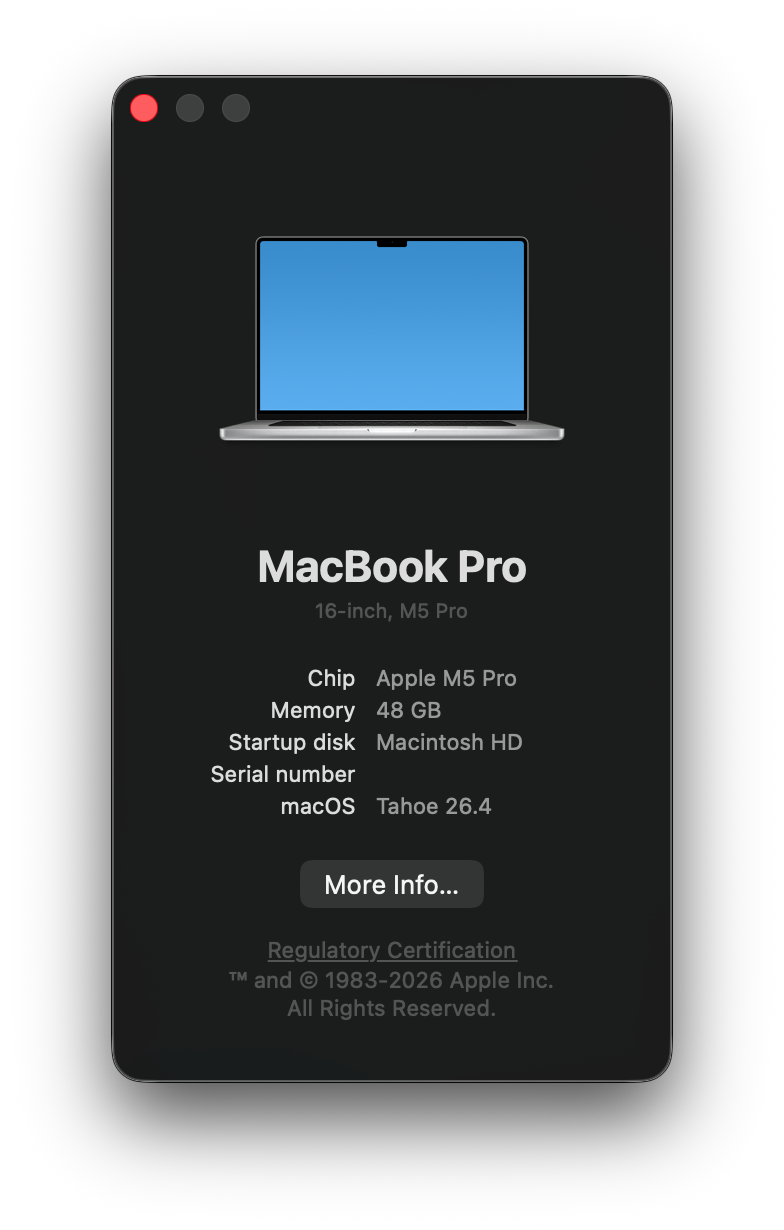
I ultimately decided on a 16" MacBook Pro with the M5 Pro chip, 48 GB of RAM, and a 1TB SSD. The final price for this configuration was a little over three grand. Not cheap by any means, but also not terrible for a modern, fully capable machine. Especially when you consider that this should be more than capable of meeting all of my requirements.
Along with the computer itself, I ordered a 2 TB Thunderbolt SSD to serve as a drive for my photography and a Thunderbolt 5 dock to use the laptop at my desk with all of my existing equipment. This ran me about another $600 (thanks to the current AI demand jacking up the price of SSDs).
My Thoughts on the Switch
At this point, I've had my new Mac for a few weeks now, and I've fully finished moving my entire workflow over to the new computer. While this change has certainly been an adjustment, I can honestly say that this is, by far, the best computer that I've ever owned.
The build quality of the MacBook Pro is unmatched by at least 99% of the PC laptops out there. Additionally, the performance of the Apple Silicon chips is insane. The laptop easily handles everything that I throw at it without even breaking a sweat.
All of this would be amazing enough on its own, but when paired with the battery life, it's unmatched by any PC that I've ever seen. The M-series chips are so power-efficient that I'm able to edit photos in Photoshop and Lightroom, cut a 4K video and render it out, then switch to some software development tasks and still have plenty of battery left over. I've truly never had a laptop that could deliver this level of performance with even a tiny fraction of the battery life.
As a fun aside, I've also not had a single issue with the Adobe suite on macOS. I have no idea if the issues on Windows are due to Windows itself, Adobe's software quality on Windows, or some combination of the two, but I can say that, so far, it has not been an issue on Mac.
With all of this in mind, I have no choice but to admit that I was wrong about the Mac. They are, in my opinion, the best laptops on the market for creative work. Everything considered, their price isn't even all that unreasonable for what they're able to deliver. Assuming Apple is able to keep this trend in the future, I can't see myself ever going back to a PC-based workflow.

Comments ()