

The Death of the Internet
The early internet felt like a digital frontier. A place loaded with personal websites, niche communities, and seemingly endless human creativity. That internet is dead, instead replaced with walls of ads, algorithmic feeds, disinformation, and AI slop.
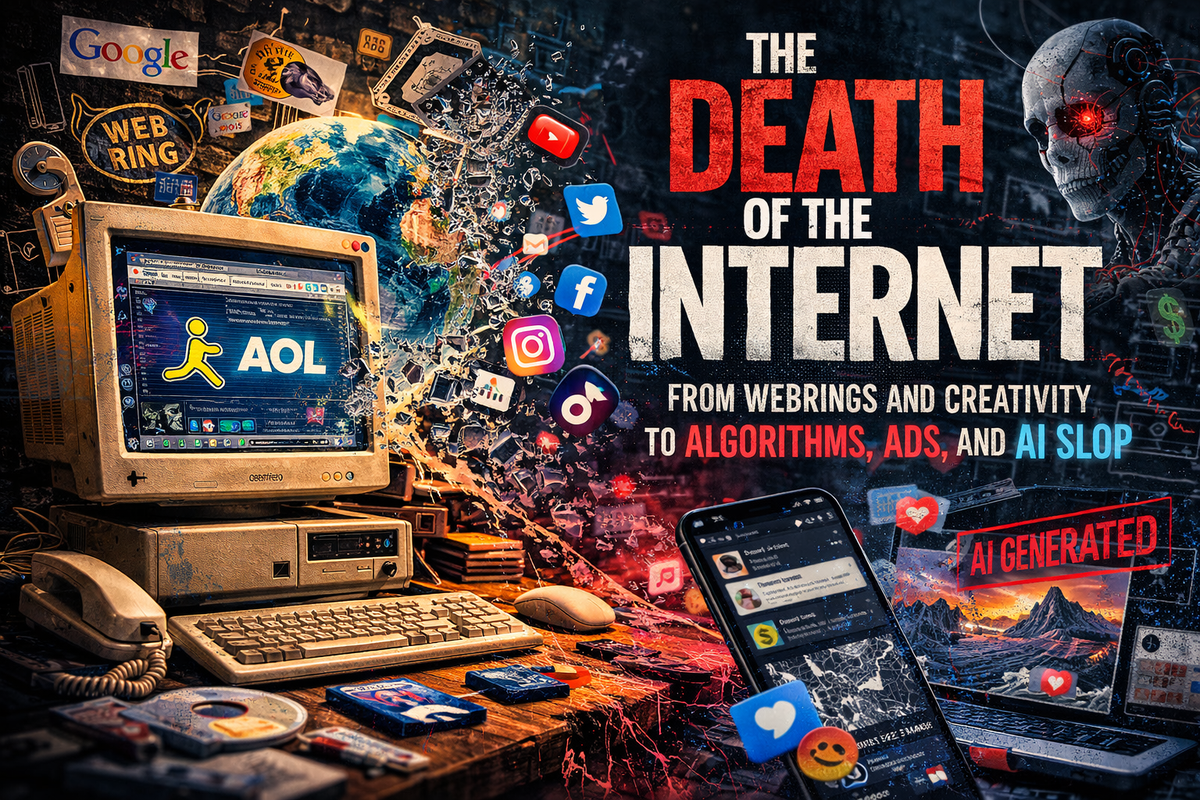
As a child of the 90s, I'm among the last generation to have grown up with the early World Wide Web. Growing up, we had a single computer in the house. I don't remember the specifics of the first computer I ever used. What I can tell you is that it was a beige behemoth running Windows 95, and it connected to the internet through a dial-up connection using AOL. Despite being a laughable setup by today's standards, this computer opened up a whole new world of possibilities.
From my living room, I could access endless amounts of knowledge and connect with other like-minded people who shared my same niche interests, unlike most of the other kids in school. This, surely, would have to be the single greatest human creation that would lead to a new era of peace and prosperity.
The internet was an amazing thing for a while but, unfortunately, that utopia has died.
The Early World Wide Web
The early internet, often referred to as the World Wide Web at the time, was like the wild west, but in a good way. Every website you visited was unique, different, and ran by an actual human. The levels of creativity and information you could find were seemingly endless.
This was during the time when you could surf the web - a term for exploring the World Wide Web and just seeing what you could find. This was when you could explore web rings to find your next rabbit hole. A time when Google Search was actually good and gave you useful results that you cared about.
No algorithms were dictating what you did or didn't see. There weren't companies endlessly shoving advertisements down your throat. And there certainly wasn't an endless stream of AI slop.
This was a wonderful time for the internet. I could find everything from learning how to program to someone's extremely niche and detailed website about trilobites.
The internet was still fairly niche at this point, but that was starting to change.
The Dawn of Advertising - Cue the Money
As time went on, the internet started to gain more and more traction with the everyday person, and not just a few of them. There were a lot of normal people flooding onto the internet. Suddenly, there was an opportunity to make money here... a lot of money.
Pretty much any popular website would be bought up by a larger publishing network. Many of these publishing networks would be swallowed up by even larger conglomerates. The once great websites that they acquired would be ripped apart and used as little more than a vessel to deliver ads to as many people as possible.
Any of the smaller websites that these conglomerates owned that weren't worth the effort to keep around (i.e., they weren't delivering enough ad revenue) were simply thrown out, along with all of the content.
The centralization of the internet continued, causing traffic to converge on a smaller and smaller number of websites. As such, these sites would fight aggressively for a bigger slice of this traffic. The masses would simply end up where the majority of the traffic was going.
As ad revenue dropped, publishers would simply insert more ads into their sites. There would be ads at the top of the site, the sides of the site, the bottom of the site, and even in the middle of the content itself. There were ads in popups, full-screen ads, ads in your email, and entire publications that were themselves nothing but advertisements.
On the old internet, websites were built for visitors. Website owners curated their content to try to connect with a loyal group of returning users. They'd never stand for this level of abuse on their sites.
This was no longer the model of the internet, however. Websites no longer expected, or even cared, if they built an audience. All they care about is funneling people to their site so they might click on an advertisement. After all, that's what makes them a quick buck. As such, this is what these websites are optimized for.
Suddenly, the game was all about search engine optimization to get your site to the top of Google. No longer were sites ranked on Google for their relevance. Now they were ranked by how well publishers could game the SEO system.
As if this wasn't bad enough, Google itself went from "the front page of the internet" - a place that served you useful and relevant content - to itself being little more than a platform to shove ads down your throat.
The Dawn of the Algorithmic Web
Before the internet, and even during the early days of the World Wide Web, most people would interact with content through TV and radio. Sure, you could decide what to watch and what to listen to, but your options were inherently limited. The producers of the various TV and radio networks largely decided what content there was for you to consume.
Then came the dawn of social media. Suddenly, users could interact with a whole lot more content than what was just available through their typical media channels. Furthermore, everyone could upvote, downvote, and share content, helping to signal what might be content that's worth consuming. They could interact directly with the creators of the content right out in the open via tweets on Twitter or comments on Facebook. Even more importantly, users could curate their own feeds based on what they followed and who they chose to interact with.
Your social media feeds simply showed you the content you chose to follow in chronological order - often referred to as a chronological feed. Users were in control of the media they consumed like never before, but things wouldn't stay this way.
Over time, the big social media outlets started rolling out and, eventually, forcing the use of what would be known as an algorithmic feed. Now, instead of simply seeing the content you followed in a nice, chronological order, you'd see content based on what complex algorithms decide you should see.
Everyone you follow, everything you like, every comment you make, and even metrics like how long you dwell on a single post, all get fed into these massive algorithms. Now, instead of seeing the work of the photographers I enjoy and follow, I see whatever the algorithm decides I should see.
All of this is, according to the social media giants, in the name of helping you discover new content. And, sure, you can certainly find some great new stuff that you may not have previously known about as a result of these algorithms. I'm certainly not going to claim that it hasn't happened even to me. But the idea that this shift towards algorithms is for the end user's benefit is, frankly, bullshit.
Just like the relentless shift to endless advertisements, this is all about money. It's about connecting you to the content that is going to give the social media platform more ad interactions and, thus, more revenue.
Furthermore, publishers once again had to find a way to game this system. No longer was it simply enough to fight to get to the top of Google or to build a loyal audience on social media. After all, what good is a massive social following if nobody is ever going to see your content?
The game now was to get as much interaction on these social platforms as you could. More interaction meant that your content would be inserted into more people's feeds. It no longer mattered what you posted, if it was good, or if it appealed to your loyal following. It only mattered that it would get interactions.
The Dawn of Misinformation and Manipulation
The introduction of algorithmic feeds had an interesting, albeit horrifying, effect on the internet. Publishers and online creators need to elicit interactions with their content to get their posts seen. As it turns out, however, one does not necessarily need to elicit positive interactions to get their content seen.
As far as the algorithms are concerned, engagement is engagement. It doesn't matter if that engagement is from a loyal following supporting the work of their favorite landscape photographer, or if it's an all out war in the comments of a post where a cutthroat argument is occurring about whatever politically polarizing subject is popular for the day. At the end of the day, engagement is engagement.
Publishers started to realize that eliciting an emotional response would get them engagement. It didn't matter if the response was positive or negative. The larger the emotional response they could trigger, the more likely they'd be to get the engagement they craved.
It was becoming evident that the best way to create larger and larger emotional responses was to sow division. You can see this pretty much anywhere you look, but one of the easiest examples is, of course, with any sort of political or complex societal issue. Everything is distilled into "simple" black and white issues. Side A against side B. Right vs. wrong. There is no middle ground, and if you don't subscribe to this viewpoint or that viewpoint, you're wrong, and you're everything wrong with the world today. Just make sure you like, share, subscribe, and comment about it to feed the engagement machine so we can get our views and make our money!
The use of social discourse to fuel the sale of ads and drive traffic to your site is bad enough, but all of this has a much darker side - the use of misinformation to shape the geopolitical environment.
The use of nations targeting public opinion for their own gains is nothing new. For example, it's known that the Soviet Union worked to increase racial tensions in the United States during the 1960s. Social media has only supercharged efforts like this. After all, in the modern world, you no longer have to get a publication like the New York Times to run your misinformation campaign. You can do it comfortably from behind a keyboard on Facebook.
Russia's weaponization of social media certainly isn't a new phenomenon nor is it likely to end any time soon.
Even China tries to get in on the disinformation action, though they're much less skillful at it than their Russian counterparts. Though that tide seems to be shifting with the ever-growing popularity of TikTok. There have been a number of studies, such as this one, that show pretty conclusively that TikTok is a critical part of China's disinformation strategy to push its own agenda.
Talk about China's and Russia's use of social media to further their geopolitical agendas certainly isn't anything new, especially here in the United States, but one would have to be extremely naive to think they're the only ones doing it. If there's a group that could stand to benefit from shifting public opinion on an issue, you better believe they're going to take advantage of the opportunity.
The Dawn of AI Slop
Everything I've mentioned up until this point has occurred before the boom in AI. The dawn of AI, or more appropriately, large language models, has completely changed the landscape of the internet.
Artificial intelligence, or AI, is nothing new. Alan Turing first proposed the idea of what he called "Thinking Machines" in 1950. The term "Artificial Intelligence" was coined in 1956 by John McCarthy. The idea of artificial intelligence has existed in some form or another since the dawn of computers.
Everything changed in 2022, however, with the launch of ChatGPT, the first large language model (LLM) to be viable for the average person. In just two months, the site had over 100 million active users and quickly became the fourth most visited website on the entire internet.
Quickly, other LLMs became available. Google's Gemini, Anthropic's Claude, and Microsoft's Copilot, just to name a few. As the models became more mature, they began incorporating generative AI into the mix, enabling things such as AI image generation.
These platforms brought the amount of effort to generate reasonably high-quality images to nearly zero. Suddenly, one could use all of this AI technology to bombard social media with a flood of, for lack of a better word, slop. We've all seen it. Posts like this one:
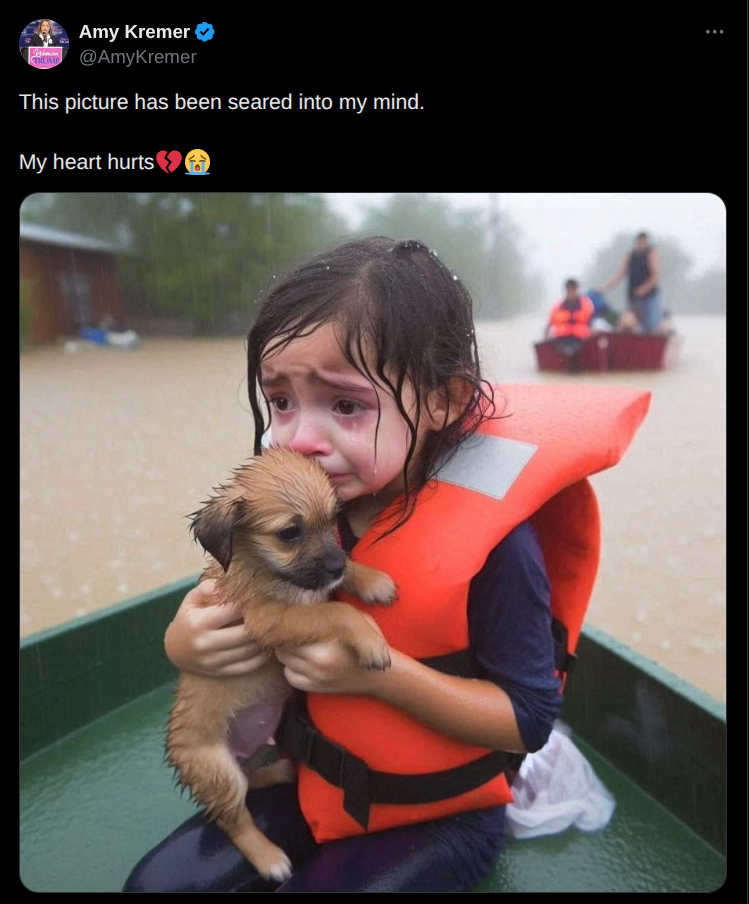
What's the point of content like this? Well, there really isn't one, per se. It all goes back to the points made in the previous section: interaction is king. With the barrier to entry for producing this kind of content being basically zero, one can just bombard their social channels with this kind of content. It doesn't matter if 90% of it doesn't stick or elicit interactions. It costs them nothing to produce it, so as long as some small percentage of it sticks and gets them the interaction they need to be shown in people's feeds, it's worth it to them.
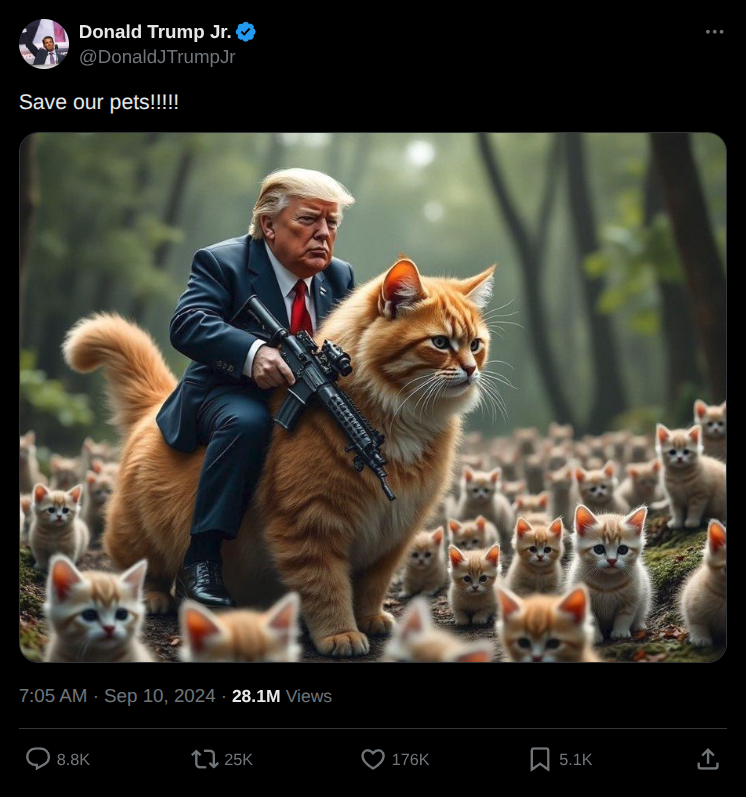
It's becoming increasingly difficult to avoid this kind of AI slop on the internet. You can't even look up a recipe without getting... whatever in the hell this is.
As if it's not bad enough that the internet is being overrun by annoying, slop content, it gets even worse. As more and more of the content on the internet is generated by AI, future AIs will be left to train on their own AI-generated content. This could even lead to complete model collapse in the future.
While the "Dead Internet Theory" is largely labeled as a silly conspiracy theory, all of this certainly doesn't make it feel too far from reality.
Enshittification
Much of what we've discussed here can be summed up as enshittification - a term coined by Cory Doctorow to describe the process in which online products and services decline in quality over time. I highly recommend that you give his book on the subject a read, but the process of enshittification, according to Doctorow, can be summarized as follows:
- Step one: The service entices users with a great and free user experience. This leads to a network effect of more and more people using the service.
- Step two: The platform extracts as much monetary value out of their users as possible. They do this by attracting a bunch of business users who buy ads that are pushed on the users. The platform will also sell the users' data to these businesses. This makes the user experience worse, but users are trapped on the platform by the network effect.
- Step three: Finally, the platform extracts as much value as they can out of its business customers. They do this by jacking up their prices and even launching their own competing products. This makes the experience worse for the business users, but they, too, are trapped because all the users are on the platform because of the aforementioned network effect.
In the end, enshittification can be summed up as something that we all experience online: services start off great but inevitably become horrible.
The Future
It's hard to say definitively what the future holds, but it's hard to imagine this situation getting any better. I think it's pretty safe to say that things are almost certain to get worse before they have any chance of getting better.
This isn't to say that it's impossible for the internet to improve. There is a path forward, and there's even steps that we can take today to avoid at least some of the hellhole that the modern web has become.
By far one of the best things we can do as individuals is actively working to reduce our dependence on the big tech conglomerates that are responsible for our current situation. I previously wrote a bit about my own journey to break up with some of the big tech in my life, but lately I've been working on doing more. Some examples of things you can do is replace the big search engines like Google with more privacy focused search engines that provide a better user experience. Examples include Duck Duck Go or Kagi.
There are also options to avoid the major social media sites and move to more of the federated social media options. As a photographer who actively works to share my work online, I realize how hard this can be (and this is something that I myself still struggle with). With that said, the more people who move away from these platforms that are actively killing the web, the more likely it is that things will eventually change.
The truth of the matter is, avoiding the big tech platforms that are responsible for the dystopian situation that we find ourselves in takes work. Big tech is the easy and convenient choice. That's why so many people just default to them and go along with their antics. It takes an active decision to make these changes in your habits, but I think it's worth it.
There's far more that I could write about this topic, but this post is already long enough! I intend to continue to share more about my own journey to break up with big tech. I hope that sharing my journey will help you with your own journey.
Comments ()